
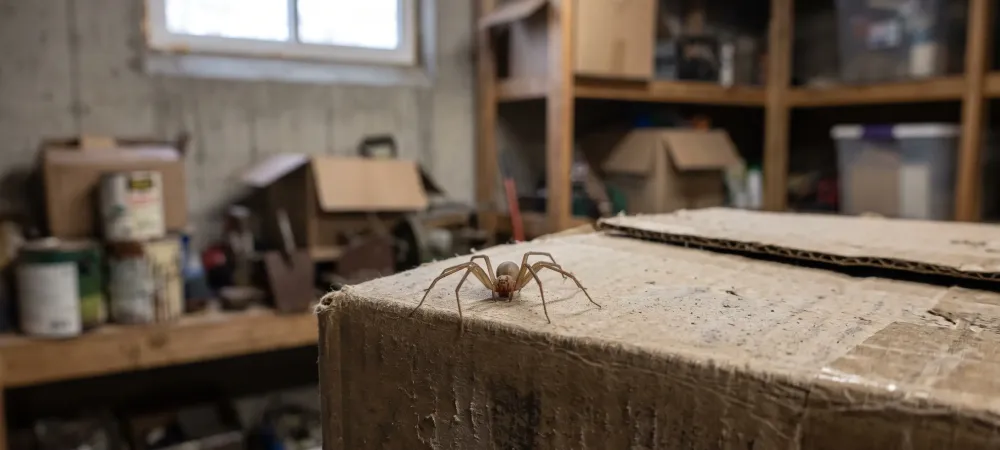
Why Brown Recluse Spiders Show Up in Oklahoma Homes Every Fall and Why Bug Bombs Won't Fix It
Brown recluse spiders don't invade Oklahoma homes in fall; they were already there. What changes in September and October is where they show up: stored clothes, shoes, cluttered storage areas, and bedding that hasn't been touched since spring. Understanding that cycle, and why standard consumer sprays and foggers can't reach them, is the difference between treating the problem and just feeling like you did.
Why Oklahoma Homes Harbor Brown Recluse Spiders
Oklahoma is home to several spider species, but the brown recluse (Loxosceles reclusa) is the one most likely to be living inside your walls right now. The state sits in the heart of the brown recluse's native range; the spider thrives in the temperate, dry-summer climate that covers Tulsa and most of northeast Oklahoma. They don't need outdoor habitat to survive. They're built for human structures: tight voids, cardboard boxes, old furniture, closet corners, and drop ceilings are ideal. Once a population establishes itself in a home, it's self-sustaining. The spiders breed, molt, and overwinter entirely indoors, which is why a single sighting rarely means a single spider.
Why September and October Are Peak Indoor Encounter Months
Brown recluse populations follow a predictable cycle. Research published in the Journal of Integrated Pest Management (2018) found that adult brown recluses typically emerge and become active in April and May, reach peak movement in summer, and begin moving to secluded overwintering sites around October. That transition is what drives fall encounters: spiders move from active hunting to sheltering, and they often find those sheltered spots inside the same home, in places people don't check regularly.
A few specific triggers push them into contact with people:
- Pulling out storage bins, seasonal clothing, or holiday decorations disturbs their hiding spots
- Cooler nights reduce insect activity outdoors, keeping spiders focused on indoor harborage
- Clutter and cardboard boxes, common in garages and basements, provide perfect overwintering cover
- Mature female spiders from spring hatches are now full-sized and more likely to be noticed
How to Confirm a Brown Recluse (Accurately)
Misidentification is common and matters, because treatment decisions should be based on what's actually present. Brown recluses have two reliable markers: a uniform tan-to-dark-brown body with no banding on the legs, and a violin-shaped marking on the top of the cephalothorax (the front body section). The neck of the violin points toward the abdomen. They also have six eyes arranged in three pairs, rather than the eight eyes most spiders have, though you'll need a close look or a macro photo to confirm that.
What they're not: wolf spiders (large, fast, hairy, often mistaken), house spiders (rounder abdomens, banded legs), or cellar spiders (long thin legs, different body shape entirely). If you catch one, a clear photo is enough for a pest control professional to make a confident ID.
Why Bug Bombs and Spray Cans Don't Work on Brown Recluses
Common Myth
Store-bought foggers, commonly called bug bombs, do not eliminate brown recluse infestations. They can't.
This isn't a marketing claim. It's documented. The same 2018 Journal of Integrated Pest Management study found that ultra-low volume (ULV) foggers, the type sold at hardware stores, had no significant effect on brown recluse populations in field conditions. Brown recluses stay in tight, sheltered voids (behind baseboards, inside walls, under boxes, in furniture cushions) that aerosol fog never penetrates. The insecticide settles on open surfaces, which recluses avoid during the day anyway.
Contact sprays from a can have the same limitation: unless you're spraying directly into a confirmed harborage area, you're treating exposed surfaces that the spider isn't on. Recluses are also more resistant to some common pyrethroids than other spider species, which makes the margin even smaller.
Effective treatment targets the harborage directly, using residual insecticides applied into cracks, voids, and tight spaces: the kind of placement that requires professional equipment and training, not a fogger set in the middle of the room.
What You Can Do Before Calling Anyone
Reducing clutter and minimizing harborage is the most effective thing a homeowner can do between professional treatments. Specifically:
- Move cardboard boxes off the floor. Use plastic bins with lids instead
- Shake out shoes, gloves, and stored clothing before putting them on, especially items that sit undisturbed for weeks
- Pull beds and furniture a few inches from the wall to eliminate direct bridge contact
- Check and seal common entry points: gaps around pipes, utility lines, and door sweeps
- Install glue boards along baseboards in areas where you've seen activity; they confirm the scope of the population and catch spiders moving across open surfaces at night
These steps reduce the number of spiders you encounter but don't eliminate an established population. A home with a multi-year infestation, especially one large enough to have egg sacs present, needs professional pest control treatment applied to the actual harborage areas.
Frequently Asked Questions
How do I know if I have a brown recluse infestation versus just seeing one spider?
A single spider can mean a single spider, or it can mean dozens living in areas you haven't checked. The more reliable indicator is glue boards: place several along baseboards in undisturbed areas (garage, basement, closets) and check them after a week. Catching more than one or two strongly suggests an established population, not a wanderer. Dandi Guaranty Pest Control can do a targeted inspection to assess the level of activity before recommending treatment.
Are brown recluse bites common in Oklahoma homes?
Bites happen when a spider is trapped against skin: putting on a shoe with a spider inside, reaching into a box, or rolling onto one in bed. They don't bite defensively in the open. Homes with established populations do see occasional bites, but they're far less common than the number of spiders present might suggest. Reducing direct contact through the habits listed above cuts the risk significantly.
Will brown recluse spiders go away on their own in winter?
No. Brown recluses overwinter indoors; they don't die off in cold temperatures the way some seasonal pests do. They slow down and become less visible, which can give the impression the problem is resolved. Come spring, activity resumes where it left off. Waiting out winter is not a treatment strategy.
What does professional brown recluse treatment involve?
Effective treatment uses residual insecticides applied directly into harborage areas: wall voids, cracks along baseboards, under appliances, inside storage areas, where contact sprays and foggers can't reach. Most protocols also include a follow-up visit to assess population reduction and treat any missed areas. The goal is eliminating the population at its source, not just the spiders moving in the open.
Seeing Brown Recluses in Your Home This Fall?
Don't guess at the size of the problem. Dandi Guaranty Pest Control can inspect the areas where they actually hide and give you a straight answer on what treatment makes sense. Call us at 918-622-7378. We're here to help.
Call Dandi Guaranty Pest ControlSources
Sandidge, J. et al. (2018). Brown Recluse Spider Biology and Control. Journal of Integrated Pest Management, 9(1). https://academic.oup.com/jipm/article/9/1/4/4818303
Oklahoma State University Extension. Spiders: Brown Recluse, Black Widow and Other Common Spiders. https://extension.okstate.edu/fact-sheets/spiders-brown-recluse-black-widow-and-other-common-spiders.html