Pigeons, Starlings, and Sparrows in Tulsa: When Birds Become a Pest Problem
If you've noticed birds gathering on your roof ledges, nesting in your dryer vent, or leaving droppings across your building's exterior, you're dealing with more than a nuisance. Pest birds are one of the most underestimated property threats in Tulsa. The damage they cause builds quietly over weeks and months until what started as a minor annoyance turns into a structural repair, a health concern, or a liability issue. This guide covers which birds are responsible, why the problem gets worse without action, and what actually solves it for the long term.
Quick Answer
Pigeons, European starlings, and house sparrows are the primary pest bird species in Tulsa, and none of them are protected under the federal Migratory Bird Treaty Act. They cause structural damage through acidic droppings and nest-clogged vents, and their waste can carry serious health risks, including histoplasmosis. Professional exclusion using physical barriers like netting, spikes, and vent covers is the only reliably long-term solution.
Key Takeaways
- Pigeons, starlings, and house sparrows are not federally protected, making removal and exclusion entirely legal when done correctly.
- A single pigeon produces up to 25 pounds of droppings per year. Those droppings are acidic enough to degrade roofing materials, gutters, and metal over time.
- DIY deterrents like plastic owl decoys and repellent sprays provide only short-term relief. Birds adapt quickly and return, often in larger numbers.
The Three Nuisance Birds Creating Problems in Tulsa
The pest bird problem in Tulsa centers on three species: feral rock pigeons, European starlings, and house sparrows. Each one is a non-native species introduced to North America at various points in history, and each thrives in the urban and suburban environments that make up the greater Tulsa area. If you're trying to identify what you're dealing with, our post on the most common wildlife in Tulsa can help you start.
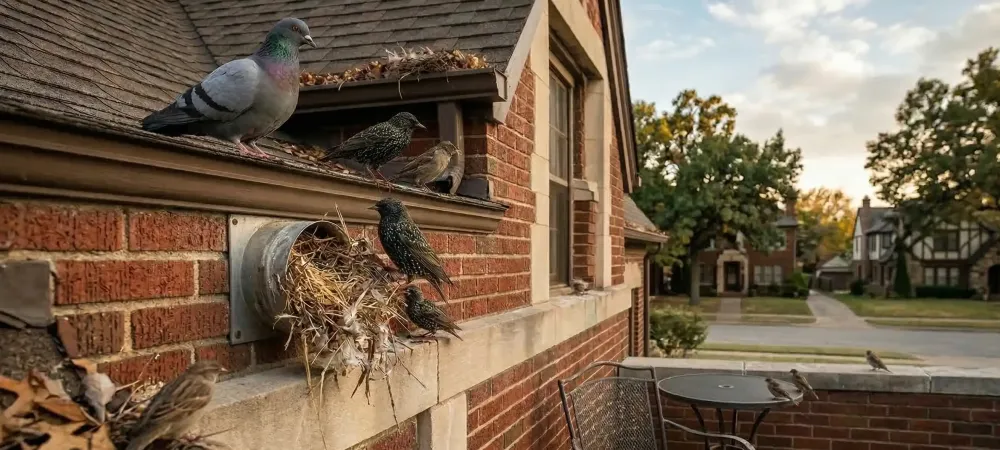
- Pigeons are the most visible pest birds in Tulsa. They roost in flocks on rooftop ledges, HVAC equipment, commercial signage, and any flat, sheltered surface they can claim. A single pigeon produces up to 25 pounds of droppings annually, and those droppings are highly acidic. Over time, they erode roofing membranes, corrode metal flashing, stain painted surfaces, and clog gutters.
- European starlings are aggressive cavity nesters. They target dryer vents, bathroom exhaust vents, HVAC intakes, soffits, and any opening they can fill. A starling nest inside an active vent creates a fire hazard and restricts airflow. Starlings typically produce two clutches of eggs per year, so a problem left unaddressed compounds quickly through a single season.
- House sparrows are the smallest of the three but among the most persistent. They build bulky, disorganized nests in gutters, under eaves, inside sign cabinets, and in any gap or crevice along a building's exterior. A pair of sparrows nesting in one overlooked spot can grow into a colony over the course of a breeding season.
Why a Bird Problem Gets More Expensive the Longer You Wait
Pest bird issues rarely stay contained. A small roost becomes an established flock. One pair of sparrows becomes a colony. And with each passing season, the damage accumulates.
Nesting materials block airflow in dryer vents and HVAC intakes, creating fire hazards and reducing equipment efficiency. Droppings accumulate on walkways, creating slip-and-fall liability for businesses. On commercial properties, visible droppings and nesting debris signal neglect to clients and customers before they ever walk through the door.
There's also the biology to consider. Birds establish strong site fidelity, which means they return to the same roost or nest site year after year. Once a location is established, displacing the birds without physically blocking access rarely works. Waiting a season doesn't make the problem easier to solve. It makes it harder.
Health Risks: Why Bird Droppings Aren't Just a Mess
The primary health concern associated with pest bird accumulations is histoplasmosis, a fungal lung infection caused by Histoplasma, a fungus that grows in dried bird and bat droppings. The Centers for Disease Control and Prevention states that "activities that involve plant matter or disturb soil, particularly soil that contains bird or bat droppings, can increase risk for histoplasmosis" (CDC, "Reducing Risk for Histoplasmosis"). The fungus becomes airborne when droppings are disturbed, which is exactly what happens during DIY nest removal or building repairs near an active roost.
The CDC also notes that "large amounts of bird or bat droppings should be cleaned up by professional companies that specialize in hazardous waste removal". This recommendation exists because the risk is real and can be easily avoided with proper precautions. Beyond histoplasmosis, bird droppings can carry Salmonella and the pathogen responsible for cryptococcosis, another fungal infection. In our experience, most homeowners don't think about any of this until they're already in the middle of cleaning up a nest, which is exactly the wrong time to find out.
Why DIY Bird Control Fails Every Time
Hardware stores and online retailers sell plenty of bird deterrent products. Plastic owl decoys, repellent gels, and peel-and-stick strip spikes are all widely available and frequently purchased. They aren't useless, but they are reliably temporary.
Stationary scare devices like owl decoys stop working within days. Birds observe them, register that they don't move or behave like a real predator, and stop responding to them entirely. Repellent gels and sprays break down in UV exposure and rain. Strip spikes, when improperly sized or spaced for the surface they're installed on, leave gaps that birds immediately find and exploit.
The deeper problem is that these products aim to deter birds without physically blocking access. Birds are adaptable and motivated. If a roost or nest site is available and nothing is physically blocking it, they will find a way to use it.
What Professional Bird Exclusion Actually Involves
Professional exclusion works on a fundamentally different principle. Instead of trying to frighten birds away, it physically closes off the sites they use. Here's what the process looks like in practice:
- Inspection and species identification. A technician walks the property to locate active nesting and roosting sites, document damage, and identify the species involved. This step matters for legal reasons. Some birds nesting near your property may be federally protected, and those nests cannot be disturbed without a permit.
- Nest removal for unprotected species. For pigeons, starlings, and house sparrows, nests can be removed and the area cleaned before any hardware is installed. Skipping this step and installing exclusion over an active nest creates additional problems.
- Barrier installation. Depending on the surface and species, solutions include stainless steel spike systems, bird netting, wire coil systems, shock track deterrents, or properly fitted vent covers. Each method is matched to the specific site rather than applied generically across the property.
- Follow-up monitoring. Exclusion installed in one season can develop gaps through weather, animal pressure, or structural changes. Follow-up visits confirm that barriers remain intact and effective as seasonal bird activity shifts.
If exclusion work reveals other gaps in your building's exterior, our guide to hidden pest entry points in Tulsa homes covers additional sealing strategies worth reviewing alongside any bird work.
Oklahoma's Bird Control Laws: What You Need to Know
The federal Migratory Bird Treaty Act protects over 1,000 native bird species and makes it illegal to disturb or remove their active nests without a federal permit. Pigeons, European starlings, and house sparrows are specifically excluded from that protection. The Federal Register confirms that house sparrows and European starlings are excluded from MBTA coverage because they are non-native species introduced to the United States through human activity (U.S. Fish and Wildlife Service).
In practical terms, this means these three species can be legally removed, their nests dismantled, and exclusion hardware installed without a federal permit. However, other species that share the same areas are protected. Native sparrows, barn swallows, and many other birds that may be nesting near your pest birds cannot be disturbed without proper authorization. Professional species identification before any removal begins isn't optional. It's what protects you legally.
Prevention Tips That Actually Help
Once a bird problem is resolved, keeping it resolved requires ongoing attention. These habits make a meaningful difference for both residential and commercial properties:
- Clean gutters at least twice per year to remove debris, standing water, and any material birds might use as a nesting base.
- Install fitted vent covers on dryer vents, bathroom exhaust vents, and HVAC intakes before early spring, when nesting activity begins.
- Eliminate food sources around the property. Open trash containers, outdoor pet food, and any stored grain or seed attract pest birds.
- Inspect your roofline after winter storms. Storm damage can create new access points that birds quickly exploit in spring.
- Schedule routine exterior inspections for commercial properties. A small nesting problem discovered early is far less expensive to address than an established colony. Our post on preventing pests from exploiting your building's exterior covers related entry-point strategies applicable to multiple pest types.
When It's Time to Call a Professional
Some bird problems exceed what a property owner can reasonably manage on their own. Consider calling a professional when:
- Birds are roosting or nesting consistently despite your use of deterrents.
- Nesting is occurring inside a vent, soffit, attic, or another enclosed space.
- Droppings are accumulating on walkways, vehicles, or building facades at a rate that creates a health or liability concern.
- A flock is returning to the same site each spring, indicating an established roost with strong site fidelity.
- The problem is in a commercial building where customer-facing appearance or employee safety is affected.
Dandi Guaranty's bird control and exclusion services cover both residential and commercial properties across Tulsa and the surrounding areas, using humane, non-lethal methods designed to hold up over multiple seasons. If your property is also experiencing broader wildlife activity, our wildlife control services address a range of species. For commercial properties with a larger footprint and pest concerns, our commercial pest control team can build a plan that covers everything at once.
Stop Letting Pest Birds Run Your Property
Pigeons, starlings, and house sparrows are persistent, adaptive, and capable of causing significant structural and financial damage in a single nesting season. Tulsa properties face active pressure from all three starting each spring, and the window to get ahead of the problem is now. Dandi Guaranty Pest Control has been protecting Oklahoma homes and businesses since 1959, and our team knows exactly how these species behave in our region. Call us or get a free estimate online today.
Sources
- Centers for Disease Control and Prevention. "About Histoplasmosis." CDC.gov, 26 Apr. 2024, www.cdc.gov/histoplasmosis/about/.
- Centers for Disease Control and Prevention. "Reducing Risk for Histoplasmosis." CDC.gov, 24 Apr. 2024, www.cdc.gov/histoplasmosis/prevention/index.html.
- U.S. Fish and Wildlife Service. "List of Bird Species to Which the Migratory Bird Treaty Act Does Not Apply." Federal Register, 16 Apr. 2020, www.federalregister.gov/documents/2020/04/16/2020-06782/list-of-bird-sp….