
Sentricon vs. Liquid Termite Treatments: Which One Actually Protects Your Oklahoma Home?
Oklahoma homeowners face a genuine termite threat in every county, and most already know they need professional protection. The harder question is which treatment method actually holds up here, where heavy clay soils, active subterranean colonies, and humid Green Country weather all factor into the answer. Liquid barrier treatments and the Sentricon Colony Elimination System are the two most common professional options, and they work in entirely different ways. Understanding that difference is what turns a generic treatment into a plan that actually fits your home.
The Quick Answer:
Liquid termite treatments create a chemical zone in the soil around your foundation to stop termites from entering. The Sentricon System uses in-ground bait stations that termites carry back to the colony, eliminating the threat at the source. For most Oklahoma homeowners, Sentricon's ongoing monitoring model is the stronger long-term option because soil shifting will not degrade bait stations the way it can erode a liquid barrier over time.
Fast Facts
- Liquid barriers stop termites at the foundation line but leave the underground colony intact and foraging for new entry points.
- The U.S. EPA registered the Sentricon System as a reduced-risk pesticide, backed by more than 60 scientific studies.
- Oklahoma's expansive clay soils shift seasonally, creating gaps in liquid barrier coverage that can allow re-entry within a few years.
Why Oklahoma Homeowners Face a Year-Round Termite Threat
Oklahoma sits in a moderate-to-heavy termite pressure zone that spans every county in the state. Oklahoma State University Extension researchers are direct about the risk: "Termites are severe wood-destroying insect pests present in all Oklahoma counties," and "the probability that termites will attack a wooden structure within a few years after construction is high in Oklahoma". The species doing most of that damage here are Reticulitermes subterranean termites, which live underground and build mud tubes up to any cellulose food source they can find, including your floor joists, wall framing, and subfloor sheathing.
Swarm season runs from March through May in the Tulsa metro and Green Country region, but active colonies keep feeding well outside of that window. You can learn more about the specific subterranean termite species in Oklahoma that threaten local homes, and what termite swarming season in Tulsa looks like when it begins each spring. The short version: if you own a home in Northeast Oklahoma, subterranean termites are already in the soil around your foundation. The question is whether your protection plan can actually stop them.
How Liquid Barrier Treatments Work
Liquid treatments have been the standard for termite control since the mid-20th century. A licensed technician trenches the soil around the foundation perimeter, applies a liquid termiticide to both the trench walls and fill soil, and, on slab-built homes, drills through the concrete at measured intervals to treat the soil beneath. The goal is to saturate enough soil to create a continuous treated zone that termites cannot cross without being affected.
Modern liquid termiticides, including fipronil-based products, use a transfer effect: termites that contact the treated soil carry the active ingredient back into the colony before dying. That mechanism makes liquid treatment significantly more effective than older repellent products, which simply pushed termites around the barrier rather than eliminating them. When applied correctly and thoroughly, a liquid treatment can provide reliable protection for five to seven years.
The limitation in Oklahoma: The expansive clay soils throughout the Tulsa area and surrounding counties absorb and release moisture differently than sandy or loam soils. Seasonal wet-dry cycles cause clay to expand, contract, and fracture over time. In our experience, this is one of the most consistent reasons Oklahoma homeowners contact us after a previous liquid treatment appears to have failed. The barrier that was complete in year one may have gaps by year three or four, and the colony that was always underground now has a path back in.
How the Sentricon System Eliminates Colonies at the Source
Sentricon operates on a different principle. Rather than placing a chemical zone between the termites and your home, it recruits foraging workers to carry the active ingredient back to the colony themselves. Here is what that looks like in practice:
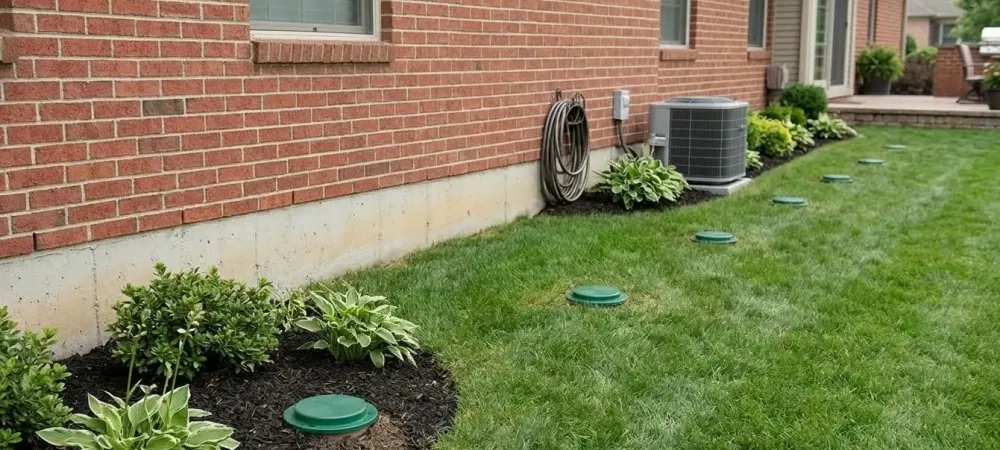
- In-ground station installation. A Certified Sentricon Specialist places bait stations at measured intervals around the exterior of the structure. No drilling into your foundation is required.
- Termites find the bait. Worker termites naturally forage through the soil and encounter the Recruit HD bait matrix. The active ingredient, noviflumuron, is a slow-acting insect growth regulator that prevents termites from molting.
- Bait is shared colony-wide. Workers share food with nestmates through a process called trophallaxis, spreading the active ingredient to the queen, reproductives, soldiers, and larvae without triggering alarm behavior.
- Colony collapse. As noviflumuron prevents successful molting across the population, termite numbers decline, and the colony is eventually eliminated. The source of the problem is gone, not just redirected.
- Scheduled monitoring maintains protection. Stations are inspected and serviced at least annually. If bait consumption indicates continued termite pressure, technicians respond promptly. Homeowners have a documented record showing their protection is actively maintained.
The U.S. EPA recognized Sentricon with its Presidential Green Chemistry Challenge Award, noting the system "eliminates termite colonies with highly specific bait applied only where termites are active" and is registered as a reduced-risk pesticide (United States Environmental Protection Agency). That registration reflects a meaningfully lower impact on soil, water, and household occupants compared to high-volume liquid application.
Sentricon vs. Liquid Treatment: An Honest Side-by-Side
North Carolina's Department of Agriculture draws the line clearly: "termiticide baits control termites by eliminating or reducing the size of the termite colony" and "do not create a barrier around the structure, as do the liquid insecticides" (North Carolina Department of Agriculture). That difference matters in practice.
- Speed of action: Liquid treatment wins here. Protection is established within days, making it the right call when structural damage is progressing, and an immediate response is needed. Sentricon works more slowly because its goal is colony elimination rather than a rapid knockdown.
- Colony source: Liquid barriers block entry but leave the underground colony intact, and foraging for new routes. Sentricon removes the colony entirely, so there is no surviving population left to find the next gap.
- Soil compatibility: Bait stations are physical in-ground units unaffected by soil chemistry. Clay expansion, cracking, and seasonal shifting do not compromise their coverage the way those same forces erode a liquid barrier over time.
- Cost: Liquid treatment has a lower upfront cost, with retreatment every 5 to 7 years. Sentricon is an annual service plan. Weighed against the average termite repair bill of $3,000 to $8,000 or more, the monitoring fee is straightforward insurance. Liquid treatment makes the most sense for pre-construction applications, when soil is fully exposed before a slab is poured.
Steps That Reduce Termite Risk Around Your Foundation
Professional treatment works best when the surrounding environment is not actively drawing termites toward your home. These habits reinforce whatever plan you have in place:
- Store firewood and lumber elevated off bare soil and away from the foundation.
- Keep gutters clear so water drains away from the home rather than saturating the foundation soil.
- Eliminate wood-to-soil contact on deck posts, steps, and fence stringers near the structure.
- Pull mulch back at least six inches from wood siding, door framing, and window framing.
- Fix leaking outdoor faucets and irrigation heads near the foundation. Moist soil is the primary driver of subterranean termite foraging.
Knowing how fall moisture drives termite activity in Oklahoma also helps you anticipate when your risk level rises between scheduled inspections.
When to Call a Certified Sentricon Specialist
If you are considering Sentricon, confirm the company holds Certified Sentricon Specialist status before signing anything. Most Tulsa-area pest control companies do not hold this designation, which means they cannot legally install or service Sentricon stations. Also, ask for a written inspection report with a site diagram, not just a verbal estimate, since a professional assessment should identify active termite zones, moisture risk areas, and wood-to-soil contact points specific to your home. Termite protection is not a one-time service. Understanding why ongoing pest protection matters is especially true here, where colonies can re-establish from adjacent soil within a few years if monitoring stops.
At Dandi Guaranty Pest Control, our 67 years of experience in the Tulsa metro and Green Country area, combined with our Certified Sentricon Specialist credential, means you get accountable, documented protection backed by a full satisfaction guarantee. Our termite treatment services cover Tulsa, Broken Arrow, Owasso, Jenks, and surrounding communities, with same-day service available when you call before noon.
Protecting Your Oklahoma Home Starts with the Right Information
Liquid termite treatments serve a purpose, particularly for new construction and severe active infestations that need an immediate response. For most Oklahoma homeowners seeking long-term, verifiable protection against subterranean termites, Sentricon's colony elimination model and documented monitoring schedule are the more reliable choice, especially given how local clay soils affect the longevity of liquid barriers over time.
Do not wait for visible damage to confirm what the soil already contains. Call Dandi Guaranty Pest Control or schedule a free termite inspection today and get a site-specific recommendation from Oklahoma's Certified Sentricon Specialists.
Sources
- North Carolina Department of Agriculture and Consumer Services. "Structural Pre-Construction Subterranean Termite Control." NC Agriculture, ncagr.gov/divisions/structural-pest-control-and-pesticides/structural/consumer-information/pre-construction-subterranean-termite-control.
- Shelton, Kevin, Brad Kard, and Jim Criswell. "Choosing a Pest Management Company to Protect Your Home Against Termites." Oklahoma State University Extension, EPP-7308, Mar. 2017, extension.okstate.edu/fact-sheets/choosing-a-pest-management-company-to-protect-your-home-against-termites.html.
- United States Environmental Protection Agency. "Presidential Green Chemistry Challenge: 2000 Designing Greener Chemicals Award." EPA Green Chemistry, 2000, www.epa.gov/greenchemistry/presidential-green-chemistry-challenge-2000-….